
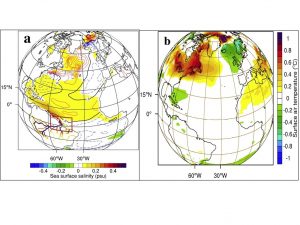
| Left panel : Response of the ocean to Amazon runoff. Amazon river network in the model is shown in with a box (red lines) where the Amazon runoff into the ocean is intercepted in the model. Shading represents the increase in salinity in the absence of Amazon overlaid with contours representing corresponding change in temperature (c) with black, red and blue contours indicating zero, increase, and decrease respectively.
Right panel: Atmospheric response in the absence of Amazon runoff. Mean winter (DJF) temperature increase (yellow and orange shades) over Eastern US, Arctic and Africa and decrease over parts of Europe (green and blue shades). |
The objective of Prof. Vinayachandran’s lab in Centre for Atmospheric and Oceanic Sciences (CAOS) of IISc in 2017 is to understand the role of river runoff into the ocean from major river systems like Amazon, Ganges-Brahmaputra, etc. on climate, using climate models.Community Earth System Model (CESM; version 1.2) was used and 200 year-long experiments were carried out by swithcing off river runoff into the ocean by individual and comparing them with the model run that includes the rivers. It was found that the largest river controls the rainfall and temperature pattern over the Atlantic Ocean, Americas and Europe. The Ganga-Brahmaputra river system that discharges into the Bay of Bengal affects the rainfall pattern associated with the monsoons.
These simulations involved 1.39 million core hours on SERC’s Cray SahasraT system. The global climate model, CESM, was used for the simulations. The parallel input/output library (PIO) facility in CESM allows several processors to write individual records to the same file.
“We have never tried these experiments on our local machines since it is a nearly impossible task.”, says Prof. Vinay.